what is the correct way to analyze a term that means "softening of the cartilage"?
The boilerplate is a simple term with several meanings. The blazon of boilerplate to use depends on whether you're adding, multiplying, grouping or dividing piece of work among the items in your set.
Quick quiz: Y'all drove to work at 30 mph, and drove back at 60 mph. What was your average speed?
Hint: Information technology's not 45 mph, and information technology doesn't matter how far your commute is. Read on to understand the many uses of this statistical tool.
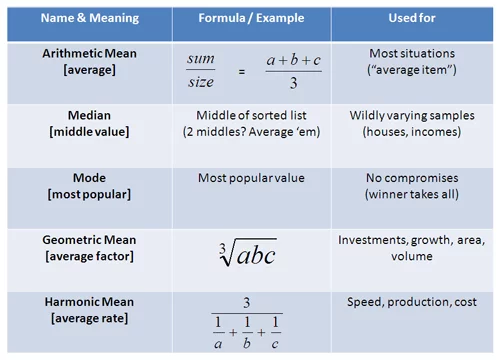
But what does it hateful?
Let'due south step back a bit: what is the "average" all about?
To about of us, it'south "the number in the center" or a number that is "balanced". I'm a fan of taking multipleviewpoints, so here's another interpretation of the average:
The average is the value that can supervene upon every existing particular, and have the same effect. If I could throw away my data and supervene upon it with one "average" value, what would information technology be?
One goal of the boilerplate is to understand a data prepare past getting a "representative" sample. Only the calculation depends on how the items in the group collaborate. Let's take a await.
The Arithmetic Hateful
The arithmetic mean is the most common blazon of average:
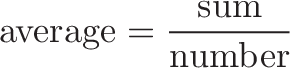

Permit'south say you lot weigh 150 lbs, and are in an elevator with a 100lb child and 350lb walrus. What's the average weight?
The existent question is "If yous replaced this merry grouping with 3 identical people and desire the same load in the lift, what should each clone weigh?"
In this case, we'd bandy in three people weighing 200 lbs each [(150 + 100 + 350)/3], and nobody would be the wiser.
Pros:
- It works well for lists that are only combined (added) together.
- Easy to summate: just add together and divide.
- It'due south intuitive — it's the number "in the center", pulled up by large values and brought downwards by smaller ones.
Cons:
- The average can be skewed past outliers — it doesn't deal well with wildly varying samples. The average of 100, 200 and -300 is 0, which is misleading.
The arithmetic mean works great 80% of the time; many quantities are added together. Unfortunately, in that location's always those 20% of situations where the average doesn't quite fit.
Median
The median is "the detail in the heart". But doesn't the average (arithmetic hateful) imply the same affair? What gives?
Humour me for a second: what's the "middle" of these numbers?
- one, 2, 3, iv, 100
Well, three is the center of the list. And although the average (22) is somewhere in the "middle", 22 doesn't actually stand for the distribution. We're more than likely to go a number closer to 3 than to 22. The boilerplate has been pulled upwardly by 100, an outlier.
The median solves this problem past taking the number in the middle of a sorted listing. If there'southward ii middle numbers (even number of items), just have their boilerplate. Outliers similar 100 merely tug the median along one item in the sorted listing, instead of making a drastic alter: the median of ane two 3 four is two.5.

Pros:
- Handles outliers well — often the most authentic representation of a group
- Splits data into two groups, each with the same number of items
Cons:
- Tin be harder to calculate: you need to sort the list first
- Not every bit well-known; when you say "median", people may remember you mean "average"
Some jokes run forth the lines of "Half of all drivers are below boilerplate. Scary, isn't information technology?". Merely actually, in your caput, you know they should be saying "half of all drivers are beneath median".
Figures like housing prices and incomes are oft given in terms of the median, since we desire an thought of the centre of the pack. Bill Gates earning a few billion actress one year might bump up the boilerplate income, but it isn't relevant to how a regular person's wage inverse. We aren't interested in "adding" incomes or house prices together — nosotros just want to find the eye one.
Over again, the type of average to use depends on how the data is used.
Style
The mode sounds strange, but information technology just ways take a vote. And sometimes a vote, not a calculation, is the best style to get a representative sample of what people desire.
Permit's say you're throwing a political party and need to pick a day (1 is Monday and vii is Lord's day). The "best" twenty-four hours would be the option that satisfies the well-nigh people: an average may not brand sense. ("Bob likes Friday and Alice likes Sunday? Saturday information technology is!").
Similarly, colors, pic preferences and much more can be measured with numbers. But once again, the ideal selection may be the mode, not the average: the "average" color or "average" movie could be… unsatisfactory (Rambo meets Pride and Prejudice).

Pros:
- Works well for exclusive voting situations (this selection or that one; no compromise)
- Gives a choice that the most people wanted (whereas the average can give a choice that nobody wanted).
- Simple to understand
Cons:
- Requires more than endeavor to compute (have to tally up the votes)
- "Winner takes all" — there's no middle path
The term "mode" isn't that common, only now y'all know what push button to look for when playing around with your favorite statistics program.
Geometric Hateful
The "average item" depends on how nosotros use our existing elements. Most of the time, items are added together and the arithmetic hateful works fine. Simply sometimes we demand to do more. When dealing with investments, area and volume, we don't add factors, we multiply them.
Let'southward endeavour an example. Which portfolio do you prefer, i.e. which has a amend typical year?
- Portfolio A: +10%, -10%, +ten%, -10%
- Portfolio B: +thirty%, -thirty%, +30%, -30%
They await pretty similar. Our everyday average (arithmetic mean) tells united states of america they're both rollercoasters, but should boilerplate out to nil turn a profit or loss. And maybe B is better because it seems to proceeds more in the skillful years. Right?
Wrongo! Talk similar that volition get you burned on the stock market: investment returns are multiplied, non added! We tin can't exist all willy-nilly and apply the arithmetic mean — we need to find the actual rate of return:
- Portfolio A:
- Return: ane.1 * .9 * 1.i * .9 = .98 (2% loss)
- Yr-over-year boilerplate: (.98)^(1/4) = 0.five% loss per twelvemonth (this happens to be almost 2%/iv because the numbers are pocket-size).
- Portfolio B:
- 1.3 * .vii * 1.three * .seven = .83 (17% loss)
- Twelvemonth-over-year average: (.83)^(1/4) = 4.6% loss per year.
A ii% vs 17% loss? That'south a huge difference! I'd stay abroad from both portfolios, simply would cull A if forced. We can't just add and divide the returns — that'southward not how exponential growth works.

Some more examples:
- Inflation rates: You have aggrandizement of 1%, 2%, and ten%. What was the average inflation during that time? (1.01 * 1.02 * i.ten)^(ane/3) = 4.3%
- Coupons: You have coupons for 50%, 25% and 35% off. Bold y'all can use them all, what's the average discount? (i.e. What coupon could exist used 3 times?). (.5 * .75 * .65)^(1/3) = 37.5%. Think of coupons as a "negative" return — for the store, anyhow.
- Area: You take a plot of land twoscore × 60 yards. What's the "average" side — i.e., how big would the respective square be? (forty * 60)^(0.5) = 49 yards.
- Book: You've got a shipping box 12 × 24 × 48 inches. What's the "average" size, i.due east. how large would the corresponding cube be? (12 * 24 * 48)^(ane/iii) = 24 inches.
I'm certain y'all can find many more examples: the geometric mean finds the "typical element" when items are multiplied together. Yous take a set of numbers, multiply them, and take the Nth root (where N is the number of items you're because).
I had wondered for a long time why the geometric mean was useful — now we know.
Harmonic Mean
The harmonic hateful is more difficult to visualize, but is yet useful. (By the way, "harmonics" refer to numbers like 1/2, one/iii — ane over anything, really.) The harmonic mean helps us calculate average rates when several items are working together. Permit's have a look.
If I have a rate of 30 mph, information technology means I get some event (going 30 miles) for every input (driving ane hour). When averaging the impact of multiple rates (X & Y), you need to think about outputs and inputs, not the raw numbers.
average rate = full output/full input

If we put both Ten and Y on a project, each doing the same amount of piece of work, what is the boilerplate rate? Suppose X is xxx mph and Y is lx mph. If nosotros take them do similar tasks (drive a mile), the reasoning is:
- X takes i/X time (one mile = 1/30 hour)
- Y takes 1/Y time (1 mile = one/lx hour)
Combining inputs and outputs we get:
- Full output: 2 miles (X and Y each contribute "1″)
- Total input: one/10 + 1/Y (each takes a different amount of time; imagine a relay race)
And the boilerplate rate, output/input, is:
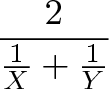
If we had 3 items in the mix (Ten, Y and Z) the boilerplate rate would be:
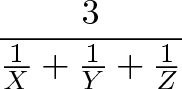
It's squeamish to have this shortcut instead of doing the algebra each time — even finding the boilerplate of 5 rates isn't so bad. With our example, we went to piece of work at 30mph and came back at 60mph. To notice the average speed, we only use the formula.
But don't nosotros demand to know how far work is? Nope! No matter how long the route is, X and Y take the same output; that is, we become R miles at speed X, and some other R miles at speed Y. The average speed is the same as going i mile at speed X and ane mile at speed Y:
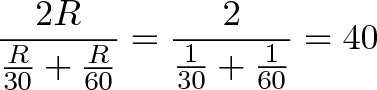
It makes sense for the boilerplate to be skewed towards the slower speed (closer to 30 than 60). Afterward all, we spend twice as much time going 30mph than 60mph: if work is 60 miles away, information technology'south 2 hours at that place and i hour back.
Primal idea: The harmonic mean is used when ii rates contribute to the same workload. Each rate is in a relay race and contributing the aforementioned amount to the output. For example, nosotros're doing a round trip to work and back. Half the result (distance traveled) is from the first rate (30mph), and the other half is from the second rate (60mph).
The gotcha: Remember that the average is a single chemical element that replaces every chemical element. In our case, we drive 40mph on the style there (instead of 30) and drive 40 mph on the way back (instead of lx). It's important to remember that we need to replace each "phase" with the average rate.
A few examples:
-
Information transmission: We're sending data between a client and server. The client sends data at 10 gigabytes/dollar, and the server receives at xx gigabytes/dollar. What's the boilerplate cost? Well, nosotros average 2 / (1/ten + i/20) = thirteen.3 gigabytes/dollar for each part. That is, we could swap the client & server for two machines that cost 13.three gb/dollar. Because data is both sent and received (each office doing "one-half the job"), our true rate is 13.3 / 2 = six.65 gb/dollar.
-
Machine productivity: We've got a motorcar that needs to prep and finish parts. When prepping, it runs at 25 widgets/hr. When finishing, it runs at 10 widgets/hour. What'south the overall rate? Well, it averages two / (1/25 + 1/10) = 14.28 widgets/hour for each stage. That is, the existing times could be replaced with two phases running at 14.28 widgets/hour for the same result. Since a role goes through both phases, the machine completes 14.28/ii = 7.14 widgets/hour.
-
Buying stocks. Suppose you buy \$1000 worth of stocks each month, no thing the price (dollar cost averaging). You pay \$25/share in Jan, \$30/share in February, and \$35/share in March. What was the boilerplate cost paid? Information technology is 3 / (1/25 + 1/30 + i/35) = \$29.43 (since you bought more at the lower cost, and less at the more expensive one). And yous accept \$3000 / 29.43 = 101.94 shares. The "workload" is a bit abstract — information technology's turning dollars into shares. Some months utilise more dollars to purchase a share than others, and in this example a loftier rate is bad.
Again, the harmonic hateful helps measure rates working together on the same consequence.
Yikes, that was tricky
The harmonic mean is tricky: if you accept split up machines running at 10 parts/hr and 20 parts/hour, then your average really is 15 parts/hr since each automobile is independent and you are adding the capabilities. In that case, the arithmetics hateful works merely fine.
Sometimes it'due south expert to double-cheque to make certain the math works out. In the auto example, we claim to produce 7.14 widgets/hour. Ok, how long would it take to make vii.14 widgets?
- Prepping: seven.fourteen / 25 = .29 hours
- Finishing: vii.14 / 10 = .71 hours
And yep, .29 + .71 = 1, so the numbers work out: it does accept one hour to make seven.fourteen widgets. When in doubt, endeavor running a few examples to make sure your average charge per unit really is what you calculated.
Conclusion
Even a unproblematic idea like the boilerplate has many uses — at that place are more uses nosotros haven't covered (middle of gravity, weighted averages, expected value). The key point is this:
- The "average item" can be seen equally the detail that could supplant all the others
- The type of average depends on how existing items are used (Added? Multiplied? Used as rates? Used as exclusive choices?)
It surprised me how useful and varied the different types of averages were for analyzing information. Happy math.
Other Posts In This Serial
- A Brief Introduction to Probability & Statistics
- An Intuitive (and Brusk) Explanation of Bayes' Theorem
- Agreement Bayes Theorem With Ratios
- Understanding the Monty Hall Problem
- How To Analyze Information Using the Average
- Understanding the Birthday Paradox
Source: https://betterexplained.com/articles/how-to-analyze-data-using-the-average/
0 Response to "what is the correct way to analyze a term that means "softening of the cartilage"?"
Postar um comentário