What Is It Like to Read the Things They Carried as a Vietnamses
Tim O'Brien'sThe Things They Carried is a footing-breaking meditation on state of war, retentivity, imagination, and the redemptive ability of storytelling. The volume depicts the men of Blastoff Company: Jimmy Cross, Henry Dobbins, Rat Kiley, Mitchell Sanders, Norman Bowker, Kiowa, and the character Tim O'Brien, who survived his tour in Vietnam to get a begetter and writer. The Harry Bribe Eye holds the author's archive.
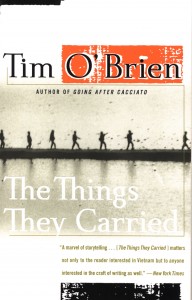
Two of the most poignant stories in The Things They Carried are "On the Rainy River" and "Field Trip." "Rainy River" portrays a young O'Brien, weeks removed from his college graduation, leaving his home in Worthington, Minnesota, for a fishing outpost on the Canadian border, agonizing over whether to report for Ground forces induction or to live as a draft dodger. In "Field Trip," O'Brien returns to Vietnam many years subsequently his bout of duty as a foot soldier and radio operator, now with his ten-year-sometime daughter, Kathleen, as he seeks some measure out of peace from the traumatic memories of a close comrade'due south death. Considering these stories are removed from the daily realities of the war, they tend to exist more accessible to O'Brien's audience. But in the original version of Things, readers would have turned the folio to discover that neither of these stories is "true."
Throughout The Things They Carried, O'Brien famously distinguishes between "happening-truth," or an accurate and verifiable business relationship of historical events, and "story truth," or readers' genuine experience of the story, even if the details are invented. The book blurs the lines between fiction and truth even further in its dedication to a grouping of soldiers who turn out to be fictional characters throughout the rest of the book, and in the appearance of "Tim O'Brien" in several stories, a effigy who seems very similar to, simply not quite identical with, the author. Many readers, and most of my students over many years of teaching the volume, accept the circumstances of "Rainy River" and "Field Trip" to exist at least more than or less truthful (in the conventional sense): they presume that O'Brien made some sort of trip abroad from his family while deciding whether to honour his typhoon observe, even if non precisely the one portrayed here, and that O'Brien and his daughter went back to Vietnam years later on the war, fifty-fifty if, again, the "real" version of that event differs from its fictional representation. (That is, they take these stories to exist relatively conventional instances of fiction based on episodes from the author's life, even if contained within a much more than complex metafictional narrative.)
In fact, while O'Brien did agonize nigh serving in a state of war he vehemently opposed, he never fabricated whatsoever trip like the 1 in "Rainy River;" his worries played out entirely in Worthington. And, while O'Brien did return to Vietnam in 1994, accompanied past his then girlfriend—this trip is the subject field of his well-known slice for The New York Times Mag, "The Vietnam in Me"—his daughter did not get with him, because he had no children. In the typescript for the volume that O'Brien sent to Houghton Mifflin, the chapter titled "Proficient Form," which discusses O'Brien's interactions with the (ostensibly real) veteran Norman Bowker, as well included a long passage disavowing any happening-truth in "Rainy River" or "Field Trip," or in diverse other events in the book, such as O'Brien's compassionate imagination of the Vietnamese life he has concluded by shooting an enemy soldier on patrol, or a postwar visit from his erstwhile company commander, Jimmy Cross. Hither is a portion of that early version (I take retained the cross-throughs every bit they appear in the copy at the Harry Bribe Center):
I don't have a daughter named Kathleen. I don't take a daughter. I don't accept children.
To my knowledge, at to the lowest degree, I never killed anyone.
Jimmy Cross never visited me at my firm in Massachusetts, because of course Jimmy Cross does not exist in the world of objects, and never did. He's purely invented, similar Martha, and like Kiowa or Mitchell Sanders and all the others.
I never ran way to the Rainy River. I wanted to—badly—but I didn't.
I came across this typescript during a calendar month-long fellowship at the Ransom Center, poring through as many of O'Brien's papers as I could, and have written nigh it more extensively in How to Revise a Truthful State of war Story: Tim O'Brien's Process of Textual Production (University of Iowa Press, 2017). Always since my first run into with this attribute of O'Brien's papers, I accept been fascinated by the question of how readers would interact differently with the book if passages like this one (and another deleted affiliate, "The Real Mary Anne," which takes the opposite tack of insisting that the heroine of "Sweetheart of the Song Tra Bong" was, confronting the odds, an bodily person) had been retained. Or, to put that counterfactual question another fashion: how might O'Brien's real readers take responded to the version(s) of The Things They Carried that could have been published, but weren't? We tin start to think through those questions past looking back further than the typescript, to the magazine versions of several chapters that appeared earlier the volume.
O'Brien's Mag Readers
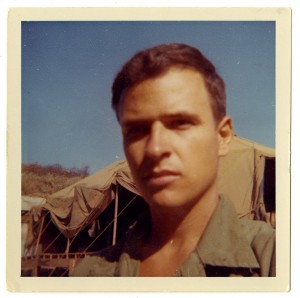
While the relationship between fiction and truth is questioned elsewhere in The Things They Carried for readers to at least reasonably doubtfulness the veracity of stories like "Rainy River" and "Field Trip," some of O'Brien's original readers would have had no such contextual cues, every bit they institute these stories in magazines. "Rainy River" appeared beginning in two periodicals: Macalester Today, O'Brien's college alumni magazine, and Playboy, which paid $5,000, the largest magazine check of O'Brien'southward career to that point. Macalester Today heightens the sense of autobiographical reality with its subheading, "A author remembers the summertime of 1968, when he institute himself in drastic trouble. A calendar month later graduating from Macalester, he was drafted to serve in Vietnam." But O'Brien'southward own introduction to the story immediately undercuts this impression, as he explains his pick to use a character who shares his name but is otherwise "near entirely invented": "Personally, I tin can't encounter that information technology matters in the least—what counts is the artifact, the piece of work itself—but still, with this book in particular, people seem interested in knowing what'south 'real' and what isn't. As with all fiction, the respond is simple: if y'all believe it, it's real; if you don't, information technology isn't." O'Brien here deftly sidesteps the question of what's "real," at least as most of his readers would sympathise it, or why they might be specially concerned about such issues with this book, for an reply that bleeds into his more than adult sense of "story truth" in the volume. Only given the context of an alumni magazine, nosotros might easily assume readers who are at least relatively predisposed to take the events in "Rainy River" as closer to "real" than they are, based not just on the question of whether they "believe it," but also on the types of stories one expects to find in this venue.
"Field Trip" appeared in the Baronial 1990 result of McCall'south, part of the mag'south "Summer Fiction Special," with a readership presumably attuned to the father-daughter relationship every bit much as the memories of wartime trauma. Indeed, the pull quote on the story'southward outset page highlights O'Brien's supposed girl as if she were the story's primal consciousness: "Kathleen was just ten, but her father wanted her to understand Vietnam, the identify where he'd lost and then much, and to witness what it was he'd detect there." McCall's readers, had they encountered a version of the volume with the passage higher up from "Skillful Form" intact, might have been particularly surprised, even dismayed, to discover Kathleen'southward fictionality. Of course, that'due south often the bespeak in The Things They Carried, as in the famous ending of "How to Tell a Truthful War Story," when the reader learns that the barbarous killing of a baby h2o buffalo was an overtly fictional episode. Identifying with O'Brien every bit a father, and/or with his immature daughter'due south attempt to make sense of a state of war she doesn't empathise, only to have the fictional rug pulled out, seems on its surface like the same kind of effect that the book goes to considerable lengths to create in its other chapters.
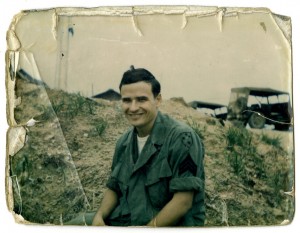
And then, why did O'Brien remove these elements of The Things They Carried? That is, why did he render the narrative less overtly metafictional, and how does this revision impact readers of the editions actually published? Function of the respond is that O'Brien's editor at Houghton Mifflin, Camille Hykes, felt the collection would be stronger without its tricks exposed quite then much. "Why should the magician pull upwardly his sleeve & tell us—Look, this is where the birds come from—when really, deep downwardly, we knew it anyhow?" she wrote to O'Brien. And O'Brien himself clearly decided this version of the book would more subtly, and more than effectively, generate its metafictional furnishings.
But I'grand non so sure. Much of the real power of The Things They Carried, for me, comes precisely from the process of building emotional investments in its characters, and and then rebuilding those relationships on different terms one time we take been told, in no uncertain terms, that the "people" nosotros accept come to care about don't "exist in the globe of objects." Nosotros probably knew information technology all along, as Hykes suggests, but the best magic tricks, afterwards all, are the ones where you know it's an illusion just still tin't quite figure out what's really "truthful."
John M. Young is a professor of English at Marshall University and author of Blackness Writers, White Publishers (2006); Publishing Black, co-edited with George Hutchinson (2013), and How to Revise a True War Story (2017). His fellowship at the Bribe Center was supported past the Norman Mailer Endowed Fund.
Source: https://sites.utexas.edu/ransomcentermagazine/2017/06/20/the-textual-truth-behind-tim-obriens-the-things-they-carried/
0 Response to "What Is It Like to Read the Things They Carried as a Vietnamses"
Postar um comentário